


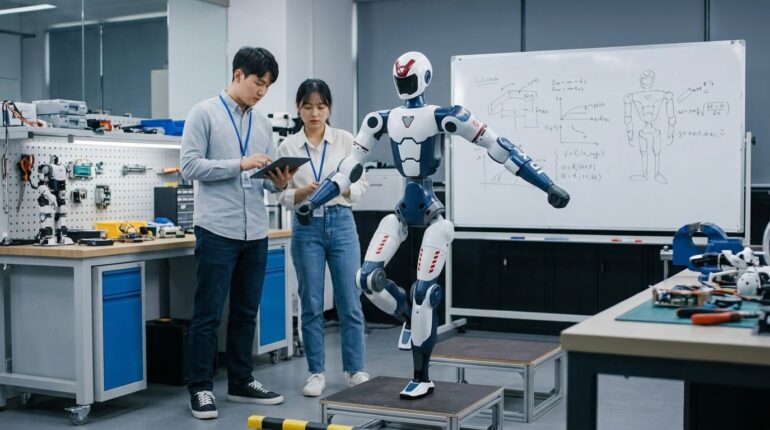
We’ve slowly let machines into our lives without realizing it. Their smartness, speed, and flexibility have exponentially increased, and even now, there aren’t many affordable models available. The competition to build a lifelike robot is rapidly progressing. Presenting their robot demos and development are Tesla with its Optimus, and the Google Mind team with Geimini Robotics 1.5. With their high price and limited access, these robots are out of reach for most of us. The good news is, Unitree is making it possible for us to have a robot in our homes.
The new Unitree R1 is a people favorite. Known for their dog-shaped robots, this Chinese robotics company has made the G1 and R1 robots. The R1 is a smaller humanoid robot and unlike most robots of its kind, R1 is a nimble robot which can run, box, and flip. Making R1 even more attractive is its price. The R1 is listed for about $5,900, making it one of the most inexpensive robots of its kind. The price of Unitree’s R1 even beats the expected price of Optimus and the Gemini Robotics. Unitree’s older G1 models were around $16,000.
Key Features of Unitree R1
These are some of the features that R1 offers that are not offered by G1 and Tesla’s Optimus:
Compact and Lightweight
Most robots as of lately have a bulky design and become a hinderance over time as they are unable to perform even the simplest of tasks. As time passes, robots are becoming more and more clever and are beginning to shed some of that bulk. For example, Unitree R1 stands at a height of 1.22m (4.0′) and a weight of 25 Kg (55 lbs). This design allows it to perform jumps and other stunts with ease. It is worth noting that the design and distribution of the weight of R1 is also a factor. The center of mass of R1 is relatively low allowing it to perform stunts such as a handstand without falling over.
The weight difference between R1 and G1 is notable. G1 used to weigh 35kg at a height of 1.32m. R1 is gaining a lot of attention since it weighs almost 10kg less. However, public reaction is mixed. While the weight loss is positive, the short stature is drawing a lot of mockery. A user on Reddit commented, “due to their short height, an average household should have at least two of them.”
R1 does not have finger sensors and has a lot of shortcomings. The same user also commented on X that, “it’s not particularly useful yet. It has a 1-hour battery life, and can’t grip or do meaningful tasks.” R1 does not have hands and that also drew a lot of mockery. People also started questioning why the hands are in glizzy grabbing mode. But since this is the first model, we should expect Unitree to make improvements in the future.
Look how every other tech company tries to make a humanlike robot. Unitree actually did it. They gave Unitree R1 humanlike motion with a great joint structure. According to Unitree’s official specs, the R1 has 24 DOF (joints). Many press releases also revealed that the number is extended to 26 DOF.
With 6 degrees of freedom on the legs, 5 degrees on each arm, the torso having 2, and the head and neck having 2, the R1 moves better than G1, which has 23 DOF. It even stays balanced when an attempt is made to knock it down. Unitree even mentioned this in their video, and has gotten negative responses to it. One example from Reddit is the following:
“Can you make me breakfast? No, but check this out” does a flip.
Victor responded on X saying that flip backs are cool, but the real hard part is being useful (cooking, cleaning, helping around the yard). Until then, it is just for show. Considering the price of $5,900 and with the level of performance, it is hard to argue the level of performance and the level for a humanoid.
Unitree has focused on this when building the R1 model. Permanent Magnet Synchronous Motors (PMSM) are a type of high performance actuation used in advanced robotics and even electric vehicles. These motors enable the robot to control its speed and provide smooth torque. They also help R1 adjust its posture in milliseconds, as shown in the demonstration video.
The motors distribute torque to maintain balance in the legs and arms even if the robot is upside down. R1’s actuators are both smaller and lighter and faster compared to G1’s. G1 struggled with balancing after movement, however, R1 allowed for easy flipping due to its lightweight nature and the use of PMSM motors. Public response to its movement is divided. One person even said on X,
“That’s awesome, the robot can do gymnastics, though it needs to be able to carry things, and be useful in other ways. Is that possible?” Truth is, backflips and gymnastic movements are impressive, but Unitree hasn’t provided clarity for the use of R1. Important movements are the ones that allow the robot to perform useful functions. This is where the focus of their innovation should go.
Battery and Power Efficiency
The most important consideration is time (duration) between charges. Obviously, we do not want to charge after every hour, but unfortunately this is where Unitree has failed. Although a smart lithium battery was used, R1 under mixed use only lasts 1 hour. This is not a popular battery choice, and one Reddit user even joked about how it will get charged every hour.
“Stick the cable in the port and just pump the robot full of electricity.”
One user said they had to charge it on a daily basis just to see backflips or get a gymnastics coach. How long the battery lasts depends on what the robot is doing, but it is still less than G1 (2 hours) and Tesla’s Optimus (8–10 hours).
Another user said they had to charge it daily just to see backflips or get a gymnastics coach. How long the battery lasts depends on what the robot is doing, but it is less than G1 (2 hours) and Tesla’s Optimus (8–10 hours).
Sensors/Vision System
It isn’t enough for robots to just know movement. They need to have eyes and ears to see and respond to the world around them. The Unitree R1 has a humanoid binocular camera, a 4-microphone array, and optional LiDAR or depth sensors. These allow the robot to see in 3D and comprehend the world around it as well as respond to voice commands.

Its stereo camera system allows it to perceive its surroundings and plan ahead of time to avoid collisions. It has microphones to listen; optional LiDAR adds to its 3D mapping. The perception system of the R1 is much better than the G1, which has only visual cameras and some primitive sensors. People still worry about their privacy because it can see and record people. Chiemeri Shared on X,
It still raises privacy concerns how it stores your interactions. Do the builders have access to the information you share? Do they have the ability to record your living space or spy on us whenever they wish?
There must be strict government laws to protect us from the technology, and the builders must be transparent about their product.
Customizable Design
The R1 gives us the opportunity to customize the design of the unit. The R1 runs on ROS 2 (Robot Operating System 2), and gives users and developers more flexibility to run and test their code. Users can modify the robot’s existing motion and perception systems, or even code custom behaviors in Python or C++. The best part is the R1 comes with an SDK and robust simulation tools. The modifications to the code and/or control systems can also be tested in a simulated environment before being deployed to the actual robot.
The R1 is more suitable for developers and educators. The G1 served research and industrial needs more effectively. The R1 supports connectivity for external devices such as LiDAR, depth cameras, and microphones.
Affordable Humanoid Robot
At USD 5,900 or ¥99,000, R1 is certainly generating excitement and media coverage for good reason. The R1 is significantly more affordably due than rival models such as Unitree’s G1 ($16,000) and H1 ($90,000), and also than units such as Tesla’s Optimus ($20,000) and Boston Dynamics’ Atlas ($200,000+). It is really even more affordable than a MacBook Pro.
The launch demonstrates China’s aspirations for humanoid robotics. The industry has an estimated value of $2.4 billion dollars and projected to reach $24 billion by 2032. This invention was listed as one of Time Magazine’s “The Best Inventions of 2025”. As for public reaction, many have been left underwhelmed and some have ridiculed the invention. Gordon Shumway commented: “That can speak to you and do backflips for $5900. My kid can do all of those for free.” Another stated, “Why would I pay $5900 for something to have someone to talk to and do backflips for me?” Many called it a pricey toy that does nothing and continued by stating that the Hugging Face bot is a better option for experimenting and exploring robotics. In the U.S., producing sophisticated robotics like this currently has significant development costs. However, this is the first step for many companies towards reducing that, and it’s nothing compared to Unitree’s costs for something like Optimus. The Unitree R1 is available for pre-order with expected delivery dates in the first quarter of 2026.
Privacy & Ethical Concerns of Unitree R1
Unitree R1 is gaining publicity due to its low cost, but due to its prior collision history, many people are concerned. A video from a Chinese factory went viral after a Unitree H1 humanoid robot tested in May 2025 began to malfunction. The test resulted in the robot fiendishly flailing its arms and legs while two engineers struggled to regain control. The video quickly spread on social media, and discussions about the safety of AI and the control mechanism of robots soon followed.
However, Unitree robots have had peculiar antics before. A video captured a Unitree humanoid robot in the crowd showing aggressiveness toward bystanders in the 2025 Spring Festival Gala in Tianjin. Although there were no injuries, it did not sit comfortably with the public and brought testing standards and public reliability into question. Many thought of the incident as a malfunction in the software or sensors and although that is the case, it adds to the existing gaping hole for the need for safety in strict standards. As for people’s concerns about the risks for surveillance in the AI ecosystem in China, there are concerns. Tech analyst Deedy Das said on LinkedIn, “It’s a platform for developers to build on, not a butler yet.”
The UniPwn Exploit in Unitree Robots
Cybersecurity specialists Andreas Markis and Kevin Finnisterre released information on the UniPwn exploit on September 20, 2025. It allows the security of the Unitree Go2, Unitree B2 quadrupeds and the Unitree G1 and H1 humanoid robots to be compromised. The exploit is alarming because it allows a compromised robot to attack other robots in its immediate vicinity. The attack can therefore spread from a single compromised unit to a large population of robots.
The use of Bluetooth (BLE) in Unitree robots is the main cause of these problems. BLE allows easier connections to Wi-Fi, but means that Unitree robots use the same secret keys. This means that a hacker could easily send a crafted Bluetooth/Wi-Fi message to the robot and gain control over it. To make matters worse, the G1 robot sends user data to a Chinese server every five minutes without any notice. Andreas Makris and Kevin Finnistere state that a hacker with access could do disruptive things with the robot.
“Some of the disruptive things that a hacker could do with access to the robot include rebooting the robot, which was done as a proof of concept. There are definitely more disruptive things that could be done.”
While Unitree tries to deal with the issues, independent researchers report that the other robots do the same thing. Because of this, trust in Unitree has been declining, especially with their robots being deployed in public spaces.
“We are now aware of security vulnerabilities related to the network that some of our customers have found using our robots. As soon this became known to us, we went to fix this right away and the majority of these fixes are complete. These updates will be made available to you very soon.”
Due to this, more and more researchers, including Víctor Mayoral-Vilches from Alias Robotics are advising customers to be cautious.
Consumers were advised to connect their robots to the internet only via secure Wi-Fi and to disable Bluetooth (BLE) for added security. Companies should be able to address such issues before their robots reach consumers. The UniPwn incident illustrates how a convenience feature can introduce an exploit. The UniPwn incident has impacted security for all future robots even though R1 was not affected.
Conclusion
The Unitree R1 shows how affordable robots can be made. At $5,900, it is one of the most affordable fully functional humanoid robots available today. The UniPwn exploit has illustrated how convenience features can quickly become security risks. The incident has highlighted that robots, including the R1, can and will be living in consumers’ homes. The affordability of the R1 comes with a tradeoff of safety, security, and reliability. While maybe not the perfect solution, the R1 is an important step in the right direction.