



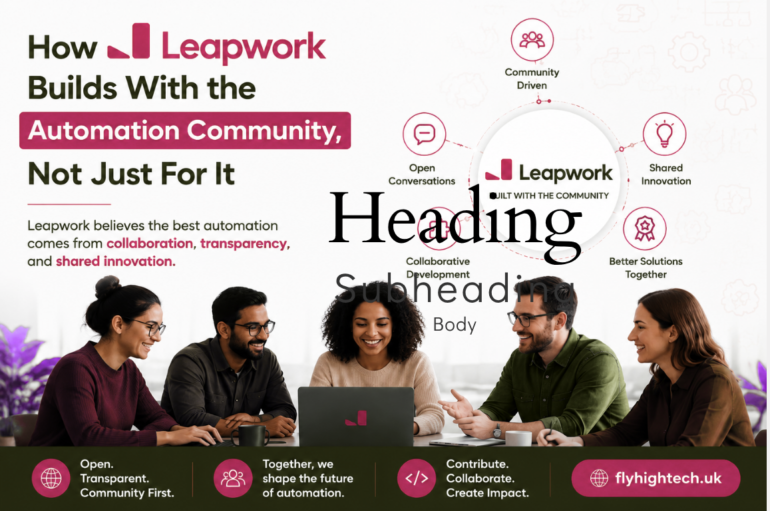
Product companies tend to feel most comfortable when they own as much of their technology stack as possible. This sense of ownership breeds a sense of control and provides the company with a proprietary solution to present to their markets, and it also easier to communicate the architecture. At Leapwork we build our solutions using Selenium and Playwright as their underlying frameworks. These tools are also used and available throughout the automation community.
This brings about a reasonable question, namely, what differentiates Leapwork Automation Community from these tools? The answer is that our differentiating factor is what we build on top of these frameworks.
Our differentiators can be seen in the processes of test intent capture and preservation, as well as in the ways in which assets can be reused. It also shows in the rules of engagement for access, execution, evidence, and reporting. It shows in the systems of engagement for test automation, testing, and quality assurance activities. It exists in the ways in which the participants of differing levels of technical skills can engage with the systems for the required degree of automation, without taking control away from engineers.
One of the primary sources of inspiration for our solutions is the community that we are creating them for. When we build and evolve our solutions, we include the learnings and experiences of the automation community. In effect, we build with the community and not just for them. Read further to see how they actively build with them.
Incorporating Accumulated Knowledge
These teams have also built up a good amount of knowledge about the business. A good example of a question that would assess the business knowledge would be including questions that assess what permissions a user requires as well as what data and systems need to exist, in what order the steps of the process need to occur, and what criteria/output the business would consider correct and/or acceptable. In most organizations, this level of knowledge is not documented anywhere else.
This is where we see the value of the automation systems, tools, and frameworks. The tools, frameworks, and systems that the teams have built and implemented have also been successful because the teams have also built up a good amount of business and automation knowledge. A good example of a question that would assess the business knowledge would be including questions that assess what permissions a user requires as well as what data and systems need to exist, in what order the steps of the process need to occur, and what criteria/output the business would consider correct and/or acceptable. In most organizations, this level of knowledge is not documented anywhere else.
This is why we have so much value in the automation systems, tools, and frameworks that the teams have also built and implemented. The tools, frameworks, and systems that the teams have built and implemented have also been successful because the teams have also built up a good amount of business and automation knowledge. A good example of a question that would assess the business knowledge would be including questions that assess what permissions a user requires as well as what data and systems need to exist, in what order the steps of the process need to occur, and what criteria/output the business would consider correct and/or acceptable. In most organizations, this level of knowledge is not documented anywhere else.
The Importance of Community Learnings and Feedback
This is where we see the value of the automation systems, tools, and frameworks. The tools, frameworks, and systems that the teams have built and implemented have also been successful because the teams have also built up a good amount of business and automation knowledge. A good example of a question that would assess the business knowledge would be including questions that assess what permissions a user requires as well as what data and systems need to exist, in what order the steps of the Another practitioner may have the exact same underlying problem, but with a totally different style of working. A practitioner may give valid reasons showing that what may appear to be an easy, obvious product solution will not work in a real enterprise situation.
Over time, all these teachings become part of our solutions. It is not one single feature that makes the differentiation; it is the product judgment that accumulates from seeing similar problems repeatedly and understanding which parts should become reusable capabilities.
As we evolve our solutions, we try to look for repeated friction rather than reacting only to the loudest request. Before we decide on new features, we try to understand the actual problems present. This is not always straightforward, as a request that sounds like a test-creation problem may really be about control. A reporting request may actually be about evidence, while a maintenance problem may have started because the original intent of the test was never captured clearly.
We believe the relationship with our communities must work in both directions. That is why Leapwork Automation Community gives knowledge back through documentation, examples, integration patterns, and practical learning. When a problem belongs in Selenium or Playwright, that should be visible. If the same enterprise problem is being solved independently by many organizations, Leapwork can turn it into a product capability so that every company does not have to build and maintain the same thing again.
Building Beyond the Foundations
Clarify what that means to us, and we will have a much stronger product story. It shows that we are using technologies that practitioners have shown to be effective.
As we develop and innovate our solutions, we start with what the automation community has already proven to us. We focus on what happens when automation goes beyond one person, who is highly skilled, or one engineering team.
As we add the features and the functionality that enterprises require to use the Leapwork Automation Community community’s proven learnings, we ask ourselves some pertinent questions.
- Who has authorization to create or adjust an automation asset?
- How is it evaluated?
- Can another team comprehend it and employ it?
- Where are the evidence and outcomes stored?
- Who has the right to investigate the absence of outcomes?
- What happens when the original creator of the automation asset leaves the organization?
- How can we accomplish execution management across several applications, environments, and teams?
The answers to these questions and planning features and product enhancements based on these functionality requests provide us the roadmap to the enterprise tier at Leapwork.
Leapwork Flow focuses on what the automation community has already proven to us and makes it easier for organizations to adopt complex business process automation.
Leapwork Go embraces performance testing automation as a foundation and adds support for organizations in managing execution and incorporating analysis and evidence for the implementation of forward and backward releases.
Leapwork Play combines automation foundation, Playwright, with the reuse and product experience governance, volumes of evidence, and outcome analysis required to automate modern web-based applications across a large and complex organization. Leapwork responds differently to the competition. There is no need to claim or pretend that we invented a certain framework.
The way we have architected our Leapwork product is key. The real test is how well we can scale our implementation of Leapwork across an enterprise and how effectively we are capable of continuing our organizational learning from the end users of Leapwork.
Building upon a foundation of Selenium and Playwright, the Leapwork team has built evidence-based, feedback-driven, and enterprise-oriented functionality around these technologies. That is why Leapwork is the Trust Layer for enterprise software delivery. For over a decade, we have supported leading enterprises across industries, regions, and application environments. We have partnered with enterprises wherever they are based on their teams, applications, and maturity.
Contact our experts today, and we’ll show you how Leapwork can help your organization move fast, build trust, and start driving ROI faster. Book a demo with our team and bring your most complex use cases.