



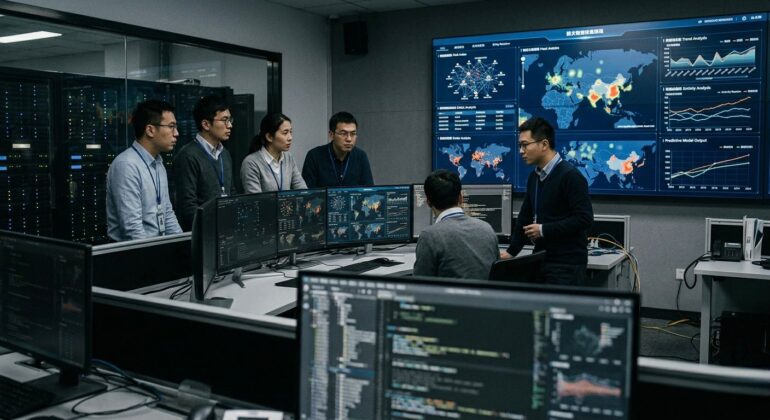
One Chinese company is trying advanced technology to assist authoritarian regimes using AI to predict probable future dissenters. This technology is very much like concepts from dystopian fiction that allow authoritarian governments to silence citizens before they are able to organize public dissent.
Geedge Networks, a Chinese company, sells a commercial copy of the Great santos vs internacional ai prediction Firewall, a piece of technology that is used by China to surveil and censor its citizens. It offers a complete toolkit to other governments to surveil citizens’ internet activity and even detect those actively circumventing censorship.
Ai ethereum price prediction 2026
From leaked internal documents, the company is researching more technologies that can criticize the government using AI to assess someone’s location and predict the probability of their dissent and actions Ai ethereum price prediction 2026. These findings were published by researchers from Vanderbilt University.
If such technologies are enacted, authoritarian regimes will be able to more effectively target their citizens. Using AI to suppress dissent is concerning itself, but in the industry it has become a nightmare to think that the technology could be used to predict dissent before actions are taken.
China is Building Predictive AI to Locate Future Political Threats: The Evolving World Competition in Developing Surveillance AI. Developing AI provides a myriad of opportunities for governments to overhaul their data collection and analytical capabilities and transform their decision-making processes. To this extent, there is much debate surrounding how the Chinese government has built AI systems to not only surveil their populations, but actively predict political threats.
Research suggests that advanced surveillance technology Chinese firms are trying to build are increasingly unable to build working predictive systems. A potential cause for this could stem from the advanced semiconductor export restrictions enforced by the United States. These restrictions will impact the development of technologies in China and the global competitive landscape in Artificial Intelligence.
Surveillance doesn’t mean inconvenience anymore. It means control.
The Move From Surveillance Systems to Predictive AI
Older versions of surveillance systems would track and record actions only after the fact. They would capture images and monitor activities via digital means.
The advancement of these systems with the modern AI abs testauslösung is an extremely sophisticated version of surveillance and is known as predictive AI.
Predictive AI seeks to answer the following:
Who is likely to dissent?
Who is likely to participate in civil unrest?
What are the social networks of civil activists?
How do authorities create “risk profiles” prior to incident occurrence?
This is the large scale of predictive governance where humans’ behavior is anticipated using algorithms, rather than responding to events that have occurred.

AI Surveillance Design in China
China has developed the most extensive and advanced system of surveillance to date, and continues to create AI surveillance systems of a modular design that incorporate:
- CCTV with city-wide, integrated, facial recognition systems
- Systems to track and analyze social media
- Systems to track the movements of mobile phones
- Systems to analyze financial transactions and the behavior of their subjects
- Systems to track the movements of citizens via the public transport systems
China is attempting to create AI systems that modularize all of these systems and analyze them to create predictive models of citizen behavior. China has a distinct interest in the ability to create categorical models of behavior through machine learning. To create systems of this design at a modular, large scale, and advanced design does require significant hardware and machine power.
The Hidden Bottleneck: Restrictions on the Exportation of US Chips
AI surveillance of this type in China is only possible with the advanced banned hardware of the US.
Surveillance AI requires powerful processors to:
- Train AI algorithms
- Analyze the enormous datasets that surveillance creates in real time
- Carry out sophisticated analytics
A constraint that limits Chinese AI systems is that companies must work with low-grade computing hardware.
This limitation affects the capability of high-end surveillance systems.
In practical terms, AI systems become less smart the longer the model takes to train.
Impacts for Chinese Tech Companies
This has, in fact, hindered some of the Chinese tech companies attempting to build predictive surveillance tech
among other things, because of:
1. Increased Lack of Computing Power
This has resulted in a lack of computing power to aid the training of AI technologies because of limited access to high-end GPUs.
2. Increased Cost to Develop
This has caused a high cost to develop due to lack of efficiency of the domestic technology.
3. Reduced Rate of Tech Development
This has resulted in a poor rate of tech development due to the long time taken to train AI technologies and low rate of incremental innovation.
4. Unorganized AI Development
This has resulted in poor development of connective technological frameworks due to a lack of resources.
While these all adversely affect development of technology, these issues, in particular, affect the rate and effort of technological development.
Ethics: Predictive and Classification Technologies
The ability to politically predict certain behaviors poses serious Ethical Issues.
- Critics argue that the systems in question:
- Use a probabilistic approach to categorize people
- Lead to a bias in predictive reasoning
- Form classification systems of “pre-crime” without predicting actions
- Are a diminishment of privacy
Are a form of social control through persistent surveillance
Unlike conventional police systems which respond to behavior, these systems respond to flawed, imperfect logic, and predictions.
This creates a new conundrum of a philosophical sort. Would a system be truly just that punishes people, not for their past, but for what they could potentially do?
Arguments for Predictive AI: Safety and Security
There is a belief that the positive impacts of predictive AI on safety and security would include abs testauslösung:
- The ability to recognize the signs of forthcoming disruption ai xrp price prediction
- A more efficient deployment of security resources
- Quicker responses during a security event
- Increased safety for the people in the city
Predictive AI is considered by its proponents to be a prevention mechanism rather than a punishment mechanism. The prevention of this system is reliant on high quality data and model transparency, which are inherently difficult to achieve.
The Global AI Race: The New Cold Tech War
The global politics surrounding the development of predictive surveillance systems increasingly resemble a multi-player game. On one side, countries are plowing resources into ai models provide varied xrp price predictions for 2026:
- AI-based governance of their own
- Nations Defense systems of analysis
- Large systems of national data
- On the other side, new export controls, trade barriers, and sanctions create new obstacles to gaining access to:
- The technology of semiconductors
- Cloud systems of computing
- Advanced frameworks of AI
The results will be even more division, fragmentation, and a globally strategically focused AI system.
The Predictive Surveillance AI of Tomorrow
Surveillance systems of AI will be dominated in the future by a trifecta of the following systems:
1. Hardware Systems
Advanced Systems of design of units will reduce the reliance on constrained systems
2. Regulation and Governance
The tightening of laws concerning the predictive and data privacy.
3. Required Transparency
AI systems will be designed to justify and explain their predictions.
As these will be in constant flux, equilibrium in the realm of security, innovation, and civil liberties will experience continual variability.
Overall Conclusion
The incorporation of AI in the management of political risk in China exemplifies the interconnectedness of global AI and the integration of security systems ai models provide varied xrp price predictions for 2026. The competitive global technologies and U.S. restrictions on chips slow these systems down and limit their potential. The main concern for this story in the digital age is about technology and its purpose.
Does technology exist to observe the present world and all its happenings or to anticipate the future and control/manipulate it before it happens?
This will shape the control of AI and societal governance for generations to come.