


Claude Science to Innovate Scientific Research
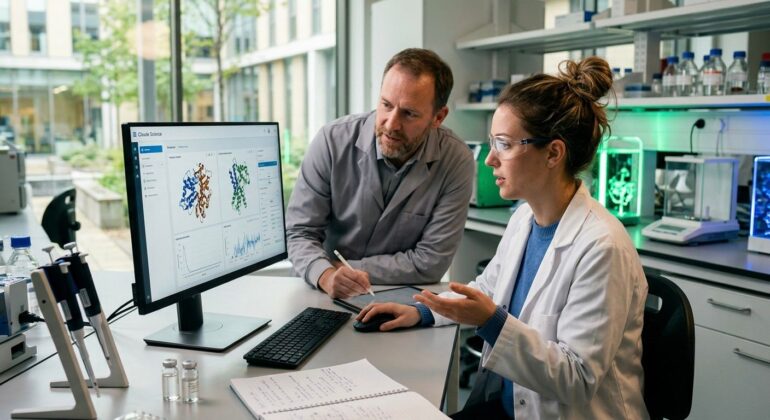
Anthropic has recently established Claude Science. Unlike traditional AI, Claude Science focuses specifically on researchers, research centers, and organizations in biopharma. The platform is built to interpret data and automate research and discovery. This is part of Anthropic’s initiative to broaden its scope in life sciences and health. AI companies’ rivalries have reached a point of transitioning from broad to narrow methodologies.
What motivated Anthropic to create Claude Science?
Analysts take a long time to assess various parameters, as this can take months. To reduce this workload, this platform has been developed. It processes and organizes information and data, and recognizes patterns with a greater level of accuracy. Anthropic scientific research intent is not to make scientists obsolete, but rather to assist scientists in allocating more of their time toward analysis and the conception and design of experiments and mechanisms.
What features does Claude Science have?
Unlike chatbots, Claude Science is capable of being applied to research.
The platform can aid researchers in:
- The analysis of research articles and literature
- The analysis of data at the molecular and cellular levels
- Aiding in the discovery and development of drugs
- The analysis of protein data
- Computational and data workflow
Team-based research assistance
By integrating advanced language models with specialized functions, Anthropic aims to offer Claude Science to universities, research labs, and research-oriented biotech and pharma companies.

Artificial Intelligence (AI) as a Collaborative Research Partner
AI’s role is rapidly evolving and has begun to take part in advanced processes in research. While AI was previously used for the generation of hypotheses, the summarization of research, and (computer) programming, AI is now developing the capacity to take part in specialized research processes, including the generation of research hypotheses, the analysis of research data, and the design of research experiments. In medicine, pharmacy, biotechnology, and chemistry, research can be carried out rapidly with the aid of specialized research tools and the capacity of the researcher to deal with millions of research data.
How is Claude Science different from available AI tools?
Numerous applications have been developed for researchers over the last few years; however, most were public implementations and used for text generation. Claude Science is an attempt to address this issue by integrating the application into the workflow of actual research and research institutions for the analysis and processing of scientific documents.
From the analysis of scientific documents, the processing of laboratory data, the analysis of protein structures, and participation in research projects for the development of pharmaceuticals, the aim is to not provide generalized solutions, but to help researchers achieve goals in their scientific endeavors quickly and accurately.
The AI race is now at the labs
The introduction of Claude Science has shown that the race of AI developers is no longer confined to chatbots or programming solutions. Now AI is attempting to infiltrate nearly every profession. Medicine, and pharmacy are included. So is academic research, chemistry, and even biotechnology!
Recently, Google Cloud and others have developed tools designed for scientific research, proving that “AI for science” is one of the dominating areas of competition in the AI industry.
What will this product mean for the future of scientific research?
If Claude Science and others like it can live up to the expectations of researchers, then the pace of performing scientific research will be unprecedented. Analysis of data, peer review of thousands of articles, the ability to discover relationships in complex data, the design of new research questions, and even more capabilities will result in an increase in the pace of research and the advancement of medical and pharmaceutical research and biotechnology.
Anthropic, of course, wants to be very clear that Claude Science will not replace anyone. It will perform the boring tasks that people do not want to do, but will allow people the freedom to do more analysis, and to be more creative and to construct ideas.
Conclusion
With the arrival of Claude Science, we can see that AI is beyond chatbots and general assistants. Anthropic’s goal to penetrate the scientific research market hinges on one of the most lucrative branches of AI. This area of artificial intelligence has to potential to innovate the efficiency of carrying out research, facilitating the discovery of pharmaceutical compounds, and revolutionizing the technological advancements of the medical field.
The AI industry is becoming overcrowded as a a result of increasing tech company investments into to developing specialized models. This has catalyzed the development of specialized, industry-tailored solutions. As a result, scientific innovation can be impacted the more than never before.
Google Cloud Launches AI Models for Scientific Research