




In 2026, ABS Testauslösung is one of the most notable diagnostic inquiries regarding vehicle safety systems. This German term translates to “ABS test triggering” or “ABS activation test.” ABS Testauslösung involves the activation of the Anti-lock Braking System (ABS) via a diagnostic program to ensure the proper functioning of the system’s sensors, hydraulic valves, and pumps, as well as the ECU.
Abs Testauslösung
As technology continues to revolutionize the automotive sector, and with the advent of electric vehicles (EVs) coupled with new brake-by-wire systems, ABS diagnostics can no longer be restricted to the vehicle dealerships. ABS Testauslösung is becoming more prevalent among Independent workshops, TÜV inspectors, various motorsport teams, and advanced DIY mechanics alike, as the need to diagnose problems before they represent a risk to safety becomes more of a necessity.
This 2026 guide will examine the workings of ABS Testauslösung, the tools it employs, its legal restrictions, as well as the diagnostic significance of more contemporary EVs in relation to ABS systems, and more frequently, the fault codes encountered.
What Is ABS Testauslösung and Why Is It Important in 2026?
The Anti-lock Braking System (ABS) is responsible for regulating the locking of vehicle wheels during hard braking. An Abs Testauslösung forces the control unit to conduct a self-diagnostic test. This results in the activation of the hydraulic pump, the cycling of the inlet and outlet valves, and a plausibility and response test of the brake system and its sensors, respectively, conducted by the ABS ECU.
Why is this so crucial in 2026?
There are a number of factors that explain the importance of ABS systems testing in 2026, to name a few:
- – German TÜV and HU inspections are increasingly demanding proof of a properly functioning ABS system; and
- – combined in the hardware systems of Hybrid and Electric vehicles (EVs) are ABS, ESP, and regenerative braking systems.
In the European Union, the incorporation of ABS into motorcycles above 125cc has become compulsory since 2016.
- After an accident, insurers can require ABS module fault memory data.
- ABS module faults can remain hidden and may not trigger warning lights.
The electronics built into modern vehicles can mask a fault as a failed wheel speed sensor or a weak ABS pump during normal driving. However, during an emergency stop, an ABS module fault can become a hidden dangerous failure.
How Abs Testauslösung Works – Technical Explanation
When an ABS testuslösung is carried out, the ABS/ESP control module runs an internal test sequence that has been programmed as a part of the system.
The following are the steps of the ABS Testuslösung procedure:
- The ignition is switched on, the engine remains off.
- For most manufacturers, terminal 15 has to be active.
- The engine must remain off to avoid interference from the vacuum booster.
- Diagnostic communication is initiated.
- A scan tool connects via OBD-II, KWP2000, UDS or DoIP.
Activation of the ABS module
The hydraulic return pump activates for several seconds, with a buzzing/whirring sound.
Interruption of valve cycling.
Each valve for the control of the wheels is pulsed in the following order:
- Front Left (FL)
- Front Right (FR)
- Rear Left (RL)
- Rear Right (RR)
- Sensor plausibility has to be checked.
The ECU checks the integrity of the wheel speed signals and electrical circuits.
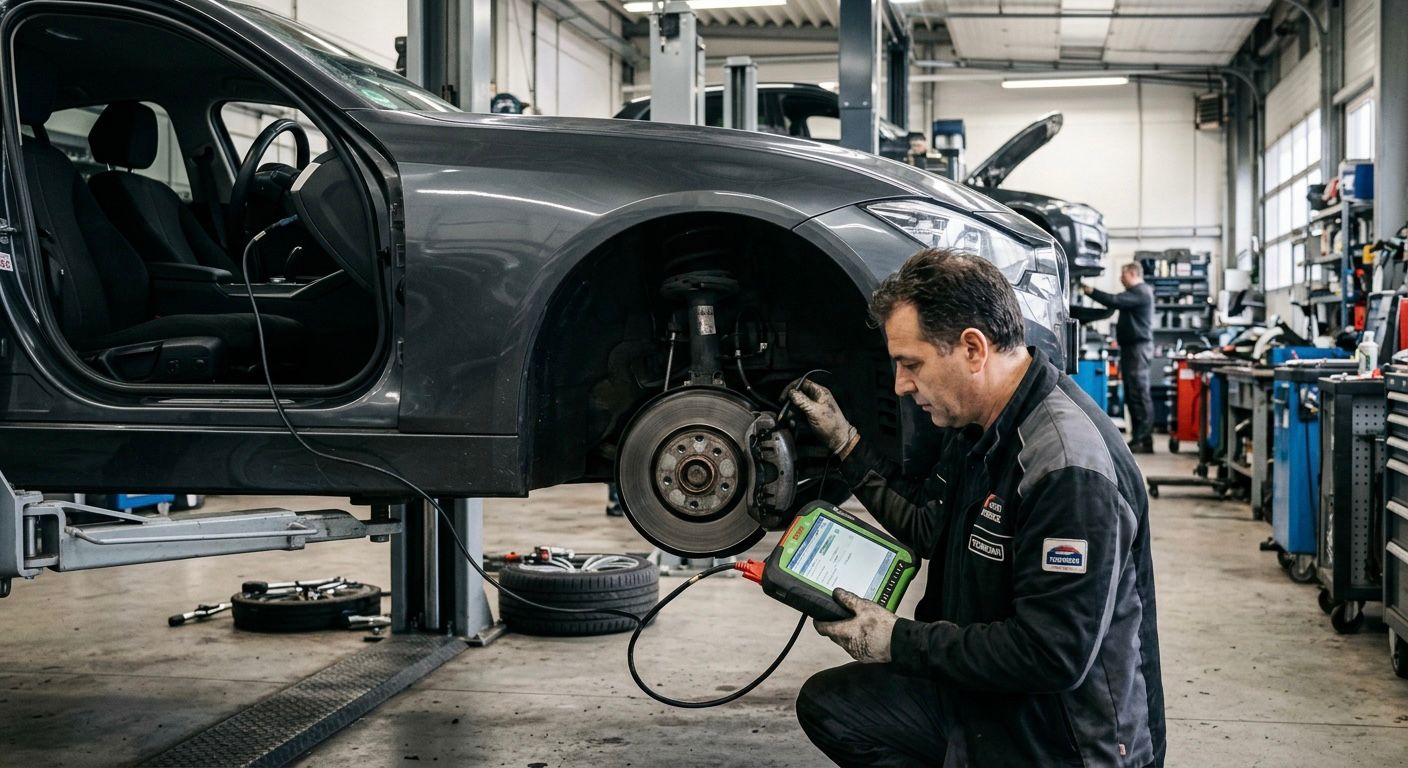
Diagnostic Results
The system will report “Test OK” or the following DTCs:
- C1100 Pump Motor Fault
- C1201 Front Left Inlet Valve Fault
Note that the ABS Testauslösung cannot substitute a driving test. While it verifies the system’s electrical and hydraulic functionality in a static condition, a dynamic brake test has to be performed to fulfill the full TÜV requirements.
Top Tools and Software for ABS Testauslösung in 2026
Not all OBD scanners are capable of performing ABS activation tests, as some only come equipped with basic features like reading fault codes. To perform ABS Testauslösung, you will need a bi-directional diagnostic tool.
OEM diagnostic systems
- Mercedes-Benz XENTRY
- “Ansteuerung ABS-Hydraulik”
- Advanced pump and valve testing
- BMW ISTA+
- “ABL ABS/DSC Test”
- Widely used for BMW and MINI
- VAG ODIS
“Grundeinstellung 03 – Bremsenelektronik”
Used for VW, Audi, Skoda, Seat
Porsche PIWIS 4
ABS/PSM activation routines
Mandatory for Porsche
A Guide on Performing ABS Testauslösung in 8 Steps
Safety is a concern for both the technician and the vehicle as electronically controlled braking systems can create a hazardous environment if activated incorrectly.
Step 1: Vehicle Preparation
Readiness of the ABS module is determined by the vehicle battery being at a state of charge of greater than 12.4V. If the vehicle battery is under 12.4V, a battery maintainer should be connected.
- The vehicle should be on a flat surface
- The handbrake should be released
- The ignition should be on (with the engine off)
Step 2: Connection of the Diagnostic Tool
The tool should be connected to the OBD-II port.
- You should then enter:
- Chassis
- ABS/ESP module
- You must read and
Step 3: Initiate ABS Testauslösung
Select from the following options:
- “Actuator Test”
- “Stellgliedtest”
- “Ansteuerung”
- Then select:
- ABS Pump Motor
- Valve for each wheel
During this step, expect the following:
The pump will run for 2–5 seconds
The brake will pulse
Step 4: Evaluate the System
If the system is in good condition:
- There will be no additional DTCs
- The pump will emit sound continuously
- The brake will remain stable
- Some common symptoms of system failure include:
- The pump will be silent, indicating a failed motor or relay
- The brake will drop due to hydraulic leakage
- One of the valves will be silent, indicating the valve is stuck
Step 5: Execute a Controlled Road Test
- After the above steps have been completed, a controlled brake test will be performed
- This test will be conducted at 30 km/h or slower
- This test may only be conducted on private property or within a controlled test area
ABS Testauslösung for TÜV, MOT, and Insurance Requirements
In Germany, the TÜV may or may not officially requirement an ABS activation test, but the inspectors do have the discretion to require it in order to clarify any inconsistencies.
Some instances in which TÜV may require an ABS test would include:
- Suspicious behavior of the ABS warning light
- Recent replacement of the ABS control module
- Importation of a vehicle where a §21 StVZO inspection is required
Modification of the brake system
In order to clarify the functionality of the system, workshops may print an ABS Testauslösung diagnostic report.
In order to clarify the functionality of the system, workshops may print an ABS Testauslösung diagnostic report.
After a collision, an insurer may consider:
- The ABS fault memory
- The pump activation history
- The DTC history
If it is discovered that the ABS system was functioning with a defect, disputes of liability may continue.
In the UK, the MOT does require that the ABS warning lights and the dashboard lights do not indicate a fault. While active ABS tests
Thoughts on ABS Testauslösung 2026
The ABS Testauslösung is extremely helpful in the evaluation of the modern auto repair and safety testing. Proper functioning of the ABS system during an emergency stop is extremely important and can save lives, regardless of whether you drive a gasoline car, hybrid SUV, electric car, or motorcycle.
Main Points
· ABS Testauslösung electronically opens pumps and valves.
· Basic OBD ii readers will NOT suffice.
· TÜV inspectors may ask for proof of the diagnostic test.
· Hidden ABS faults are frequent.
· EVs are altering Brake diagnostics quickly.
The system is now an industry standard procedure. For DIY customers, a good bi-directional scan tool can help avoid expensive repairs and safety threats in the future.
If the ABS system warning light is illuminated, brake components have been replaced or if there is inconsistent braking behavior, performing an ABS Testauslösung may be one of the quickest and most effective ways to determine that your braking system is safe in the year 2026.