



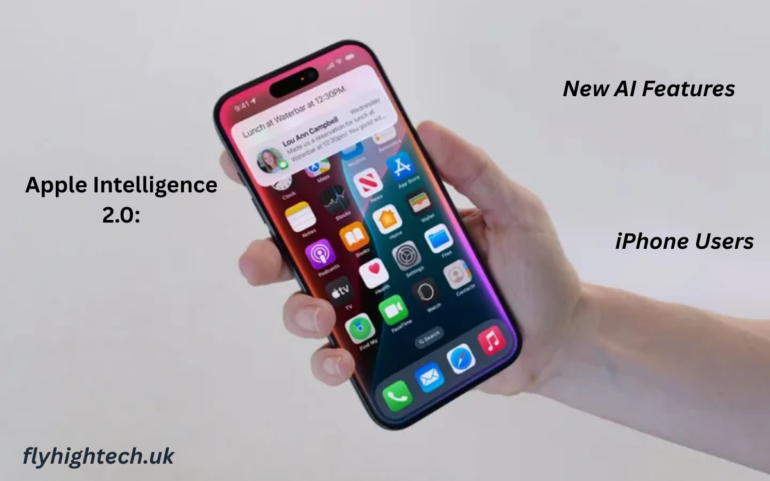
For many years, Apple tried to sell their product by claiming that they protect people’s data while Google does not. Then, at WWDC 2026, Apple stated that Gemini, Google’s product, will now be one of the engines that run Siri. This is a huge shift.
At WWDC 2026 on June 20, Apple announced a new generation of their Apple Intelligence product, which includes a rebuilt Siri, AI integrated into the native apps, and a new partnership with Google’s Gemini model. The update is being referred to as Apple Intelligence 2.0. This is not an official name from Apple, but it is a fitting description for the dramatic change that they incorporated. According to Apple, the goal for the new product is to allow customers to feel that AI is now integrated into the iPhone product, rather than being taken to a separate platform.
Let’s Talk About The Unspoken Contradiction
For many years, Apple has tried to sell their product based on not being Google. This includes the anti-tracking framework. The App Tracking Transparency framework has lost Meta billions in revenue because of Apple’s private Relay. Also, there is the option of Hide My Email. Through all of these different frameworks, Apple has continued a clear message: Apple does not provide your data to advertising companies, so your data is yours.
Then WWDC 2026 came. Google’s business model is based on the data Apple has kept from them for over a decade, and now Google is one of the companies powering Apple’s leading AI feature. Apple is allowing Siri to choose AI models, and Gemini is most likely the pick. Apple hasn’t detailed how much access Gemini has, what it can see, and what data is sent to Google when Siri uses Gemini to answer a user’s request. This isn’t a trivial detail. This is what makes Apple Intelligence 2.0 something really interesting and really complex.
What Actually is Siri AI Now
Let’s start with the catch all feature. Siri has a lot of baggage. So much that, the assistant is used for timers, weather, and to argue with a glowing orb that hears everything but the important questions. Apple won’t have you believe otherwise. They are saying the relaunch of Siri is a reset, and a belief that the first version of Apple Intelligence which was launched in 2024, was not the final version.
The version of Siri AI that people will now be able to use can scan your Messages, Emails, Documents, and Calendar to help with context specific queries. Siri will also be able to see what you’re looking at and respond to questions you have about it and will be able to control multiple apps simultaneously, as opposed to simply opening them.
That last example is the one Apple keeps going back to, and for good reason. It shows the exact scenario in which the current Siri would force you to put the call on hold, open Mail, and manually search for the code to find it, all while switching back and reading it to the person on the phone. Apple claims Siri AI will remove that friction.
If that’s true, we will find out from developer beta users. AI features have been notoriously hit or miss in terms of their actual functionality after being announced.
Call Context: A Long-Awaited Feature
Call Context was the Siri AI feature that Apple described most extensively during WWDC. Essentially, Siri would now offer a confirmation number or reservation code from Mail without you needing to step away from your call. It may sound unimportant, but for those who have spent twenty minutes on hold while searching three apps for a booking reference code, they know how useful that would be. For this to be a reality, Siri would essentially have to be reading your personal emails. So, in theory, that would be apple intelligence news having your personal email on essentially a third-party model AI, so it does require some level of trust in Apple.
So the convenience and the privacy questions are really the same thing. Apple says their privacy protections are in place. With the Gemini model being involved, we really don’t know what that actually will look like.
Writing Tools, Visual Search, and the Camera
Rather than focusing the user’s attention on a new tool, AI writing help is integrated where users type text directly. This serves a purpose. Since most people use writing help mainly a few related tasks, this form of integration makes the friction of writing assistance almost nonexistent at the point of need. More visual search features using the camera have been integrated. Simply point and ask. The more close integration of the camera with Siri means more seamless engagement.
The photo feature has more tools. Cleanup, editing suggestions, and photo organization have also expanded. These were also part of the original Apple Intelligence 1.0 and remain some of the most utilized features. Apple Intelligence focuses on aiding usability and should not require users to prompt engineer. Digital Trends’ coverage is also a great framing. When designing the AI, Apple aims to make the phone feel as though it has an understanding of the task rather than create a new category of tasks for users to fulfill.
Boring Plumbing that Makes Everything Work
There’s no point in any of the Siri AI features without app developers exposing what Siri needs for app access. At the core of this is the developer framework known as App Intents. App Intents helps app developers link their app features and functions to Siri AI. It helps Siri AI understand a user’s personal context, and what actions are to be done/visible on the screen. When an app is developed aptly with App Intents, Siri does a lot of things in that app. When Siri does not perform actions in an app, it can at least inform users that the app is available and it will open the app for the user.
Most users will not know what “App Intents” mean. Instead, when Siri is unable to perform any action in a third-party app, it is likely the app developer has not integrated App Intents in a meaningful way. This is the least exciting part of Apple Intelligence 2.0 and is likely the most critical. A better model is able to respond to better questions. An assistant, which is unable to function in the most commonly used apps, is still performing a magic trick with a seam.
The developer ecosystem needs to adapt for this to work at the level Apple envisions. That takes years, not months. Apple’s timeline for this is built on the assumption that developers will adopt this technology. When and if they do is the unknown factor in every single Siri AI use case.
Where Apple Intelligence 2.0 Does Not Work
Siri AI will be in beta later this year, but not at the iOS 27 launch. In beta, it will only work with English. It will not be in the EU under iOS, iPadOS, or watchOS at launch, as Apple is still negotiating the compliance of the Digital Markets Act. It will also be absent in China during the compliance process there.
Siri AI will be absent in the two of the three largest markets for smartphones, the EU and China, and will only be English for software that has hundreds of millions of users that use it in many other languages. This will be the most important AI integration for Apple in their largest software release of 2026. The rollout of AI features has been extremely uneven. Apple Intelligence 2.0 does not resolve that.
The Real Test: Small Moments, Not Big Demonstrations
Apple Intelligence 2.0 will also be assessed as prior AI features that Apple has released: Does it operate small, basic tasks in a better and more helpful way than the user can do themselves? Can it find a flight code in the middle of a call? Can it create a follow up email that is not a generic corporate email? Can it edit a picture without leaving the current app? Can it answer a question without making the user describe what is on screen?
These use cases are not dramatic, and in fact, they highlight the common friction points that consumers experience over the course of normal phone usage. It is harder to build a user-friendly chatbot that demonstrates the functionality of AI in a strikingly impressive way, than it is to remove these friction points silently, and without drawing attention to the fact that AI is performing these tasks.
Apple has been trying to “thread that needle” for the last four years, and the recent iteration is a more sophisticated attempt. Whether this marks a genuine “breakthrough” ultimately depends on Siri, the adoption of App Intents, the Gemini integration being seamless, and a successful expansion into non-English-speaking markets before competitors beat Apple to it.
After years of Siri serving largely as a timer tool, Apple is now, for the first time, making a real effort to bring functionality and purpose to the tool. Whether that effort solves the actual problem, rather than aims to distract from it, depends on the next 12 months and not the keynote address.
FAQs
What is Apple Intelligence 2.0?
Apple Intelligence 2.0 is the informal name for the next generation of Apple Intelligence, revealed at WWDC 2026. apple intelligence news features a reimagined Siri AI with personal context comprehension, Call Context to provide information in real time during calls, AI-driven writing assistance in all the native apps, camera-based visual search, and enhanced editing tools for photos. According to Apple, this is the “next generation of Apple Intelligence.”
What is Siri AI in iOS 27?
Siri AI is the next generation of Siri, and is context-aware by the search of messages, emails, photos, and calendar events. Siri AI is able to access what is displayed on the screen of the device, and is able to respond to queries related to that information. Siri AI is able to perform operations across various apps, and is able to provide information that is needed in a phone call, such as a flight confirmation code, which is found in the Mail app.
Does Apple Intelligence contain Google Gemini?
Yes. During WWDC 2026, Apple announced that Siri will be the first of many applications to integrate third party AI models, Google’s Gemini among them. This integration of Google AI with Apple AI is a significant shift of Apple’s AI strategy. This also opens the door to the unaddressed concerns of data access and privacy, which Apple has not discussed.
What prevents Siri AI from being available at launch in the EU and China?
Siri AI will not be available in the EU on iOS, iPadOS, and watchOS due to the EU’s Digital Markets Act and regulatory concerns in China. Siri AI will be an English beta version available later this year.
What is Call Context in Apple Intelligence 2.0?
Call Context is a feature of Siri AI that helps you find relevant personal information (like an airline booking confirmation code) during a live phone call (in this case, while speaking to the airline). It is meant to reduce the need to space the call and look for it manually.
What is App Intents, and why is it relevant?
App Intents is a developer framework of Apple that lets developers of third-party apps share their app functionalities and content to Siri AI. This is the framework that Apple Intelligence features use to determine whether Siri can perform actions within a third-party app. In the absence of App Intents, Siri can only launch third-party apps.